Combine device and connection signals without mixing their meaning
Combine device and connection signals without mixing their meaning. This guide is for device-fingerprinting implementers. Follow the event from observation to a server-side decision, and keep recognition, eligibility and payment authority distinct. The practical goal is to avoid mistaking identifier churn for a new person or a duplicate device for fraud while making the evidence reviewable.
Summarize with AI
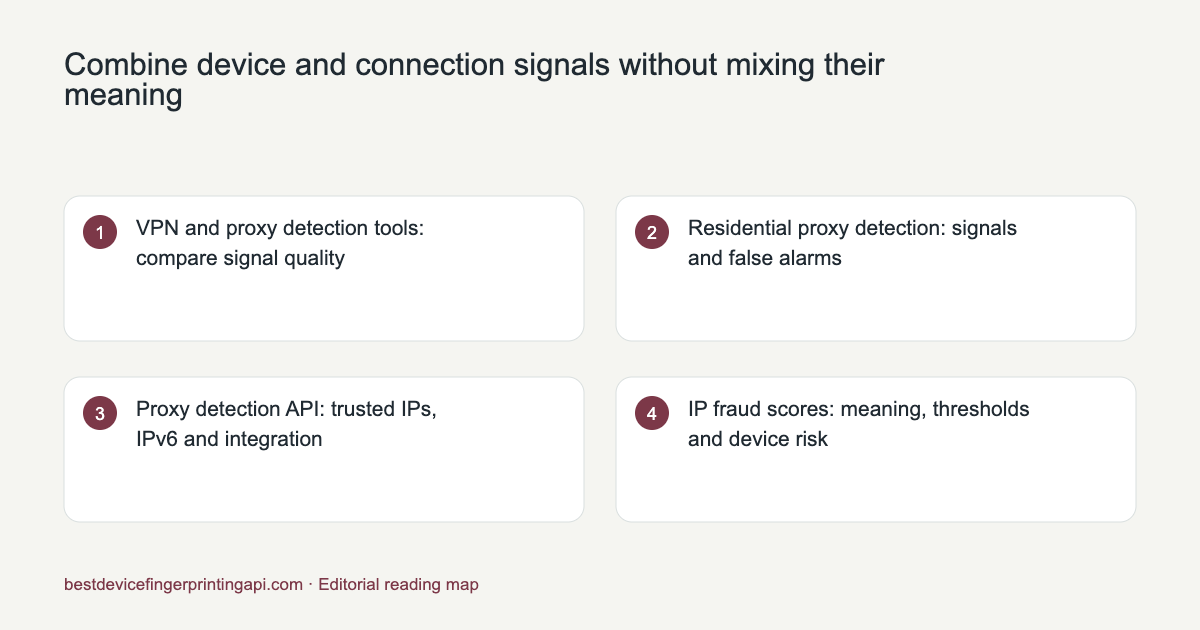
VPN and proxy detection tools: compare signal quality
A proxy detector and a fingerprint API observe different layers. Compare ShieldLabs, Fingerprint, IPQualityScore, SEON and MaxMind for network categories, recognition and decision evidence. Verify whether a result concerns the current address, an observed session or a linked account. A VPN flag does not identify the person, establish abusive intent or guarantee continuity across every private-browsing configuration.
Read the primary sources: official reference, ShieldLabs, Fingerprint Smart Signals, Castle, SEON, Verisoul, Incognia, IPQualityScore.
Residential proxy detection: signals and false alarms
A browser can remain recognizable while its residential exit changes, but recognition and proxy classification still have separate error modes. Inspect both results and their timestamps. An ISP-owned address is not automatically direct traffic. Test repeated legitimate sessions, shared carrier connections and known authorized proxy cases rather than inferring detection accuracy from an address's residential label.
Read the primary sources: official reference.
Proxy detection API: trusted IPs, IPv6 and integration
Keep IP classification and client-event verification distinct in an API integration. An IP lookup may not require a browser SDK, while device evidence usually does. Preserve the original IPv4 or IPv6 address through trusted ingress and document unsupported cases. Apple's Private Relay ranges identify its relay exits; that does not reveal a user's original address or prove every vendor detects the service.
Read the primary sources: official reference, Trusted ingress headers.
IP fraud scores: meaning, thresholds and device risk
IP reputation and device reputation have different keys and histories. A shared address can aggregate unrelated customers; a device link can also be uncertain on shared equipment. Ask which evidence feeds the score and whether the scale is calibrated to an outcome. IPQS and other providers use their own definitions, so copying a threshold between products is not a meaningful comparison.
Read the primary sources: official reference.
Location spoofing detection: evidence without guesswork
Location evidence needs provenance: IP geolocation, permission-based device coordinates and historical behavior are different observations. Keep timestamps and accuracy with coordinates. Incognia describes mobile location and device use cases, while browser-only integrations have different access. A disagreement can reveal inconsistency without proving fraud; test actual travelers and denied permissions before automating a response.
Read the primary sources: official reference.
Anti-detect browser detection: consistency and context
Anti-detect environments complicate recognition by changing attributes or isolating storage. Test the provider's tampering and inconsistency signals separately from ordinary identifier continuity. A noisy canvas or unusual browser profile is not conclusive abuse. For authorized testing, document expected environment changes and compare false links as well as missed links rather than seeking a supposedly permanent hardware identity.
Read the primary sources: official reference.
TLS and HTTP fingerprinting: JA4, HTTP/2 and context
Server-side connection fingerprints complement JavaScript attributes. JA4 concerns TLS characteristics; HTTP/2 behavior and JA4T's TCP observations are separate signals. Use FoxIO's implementation documentation for the correct generator and input layer. The result can describe many devices running similar software. Do not substitute it for a unique hardware ID or assume it survives every intervening proxy unchanged.
Read the primary sources: official reference, Cloudflare JA4.
Anonymity checks: browser observations and their limits
A privacy or anonymity test is a snapshot from one observer. It may display network and browser attributes, but a unique-looking fingerprint does not quantify tracking across the entire web. Compare repeat runs under controlled settings and document the fields actually exposed. Do not confuse a public checker with a vendor sandbox or assume a demo predicts production recognition quality.
Read the primary sources: official reference.
Distinguish data-access networks from cross-merchant fraud intelligence
Cross-device, cross-merchant and mobile-proxy requirements describe different joins. Name the actual identity object and data rights before comparing these products with a browser-recognition API.
| Requirement | Relevant candidates or evidence |
|---|---|
| Authorized mobile data access | Oxylabs mobile-proxy endpoints, targeting and session controls; Bright Data network methodology |
| Commerce-network risk intelligence | Forter, Signifyd and Sift |
| Authenticated cross-device history | Account events with a justified identity join |
| Probabilistic recognition | Relationship or match evidence with uncertainty |
| Merchant access to data | The actual permissions and fields in the proposed product contract |
Primary references: Oxylabs mobile proxies, Bright Data methodology, Forter identity intelligence, Signifyd commerce network, Sift.
Select network evidence for login and payment without blanket bans
A fingerprint buyer may add network context without changing the identity model. ShieldLabs combines the two evidence layers, Fingerprint documents identity and Smart Signals, and IPQS or MaxMind provide focused network products. Select the actual returned fields and preserve their separate meanings.
| Need | Starting candidates |
|---|---|
| Combined network/device and account-risk evidence | ShieldLabs |
| Focused IP enrichment | IPQS, MaxMind |
| Managed identity with documented Smart Signals | Fingerprint |
| Configurable fraud journeys | SEON |
| Native mobile location behavior | Incognia |
Primary references: ShieldLabs, IPQS, Fingerprint Smart Signals, MaxMind anonymizer data, SEON, Incognia.
Work through the decision
Hypothetical combined test: retrieve a browser event and an IP lookup for the same attempted action. Confirm that trusted ingress supplied the actual client address, not the application proxy. Preserve IPv6 and record when each result was produced. Compare the relationship through a network change without assuming the two APIs share an identity model. A missing JA4 value or denied location permission should remain a missing observation, not an invented clean or malicious result.
| Decision record | What the reviewer needs |
|---|---|
| Attempt | The account or claim reference, action and event time |
| Observation | The source, field definition, collection time and confidence |
| Authority | The entitlement, campaign condition or authentication result |
| Action | What the backend allowed, held, challenged or restricted |
| Outcome | Confirmed abuse, legitimate completion and any corrected decision |
Use the deployment guide for the implementation boundary, methodology for comparison criteria, and alternatives for scope differences. The checker directory identifies diagnostic access. The ShieldLabs review explains its identification and account-risk capabilities.
Sources
- MaxMind anonymizer data · read
- ShieldLabs · read
- Fingerprint Smart Signals · read
- Castle · read
- SEON · read
- official reference · read
- Incognia · read
- IPQS · read
- official reference · read
- Trusted ingress headers · read
- official reference · read
- official reference · read
- Cloudflare JA4 · read
- official reference · read
- Oxylabs mobile proxies · read
- Bright Data methodology · read
- Forter identity intelligence · read
- Signifyd commerce network · read
- Sift · read
Continue reading
FAQ
How does residential proxy detection differ from identifying an ISP?
A browser can remain recognizable while its residential exit changes, but recognition and proxy classification still have separate error modes. Inspect both results and their timestamps. An ISP-owned address is not automatically direct traffic. Test repeated legitimate sessions, shared carrier connections and known authorized proxy cases rather than inferring detection accuracy from an address's residential label.
Which address should a proxy detection API evaluate?
Keep IP classification and client-event verification distinct in an API integration. An IP lookup may not require a browser SDK, while device evidence usually does. Preserve the original IPv4 or IPv6 address through trusted ingress and document unsupported cases. Apple's Private Relay ranges identify its relay exits; that does not reveal a user's original address or prove every vendor detects the service.
Does an IP fraud score prove that a customer is fraudulent?
IP reputation and device reputation have different keys and histories. A shared address can aggregate unrelated customers; a device link can also be uncertain on shared equipment. Ask which evidence feeds the score and whether the scale is calibrated to an outcome. IPQS and other providers use their own definitions, so copying a threshold between products is not a meaningful comparison.