Use recognition for benefit eligibility without overclaiming identity
Use recognition for benefit eligibility without overclaiming identity. This guide is for device-fingerprinting implementers. Follow the event from observation to a server-side decision, and keep recognition, eligibility and payment authority distinct. The practical goal is to avoid mistaking identifier churn for a new person or a duplicate device for fraud while making the evidence reviewable.
Summarize with AI
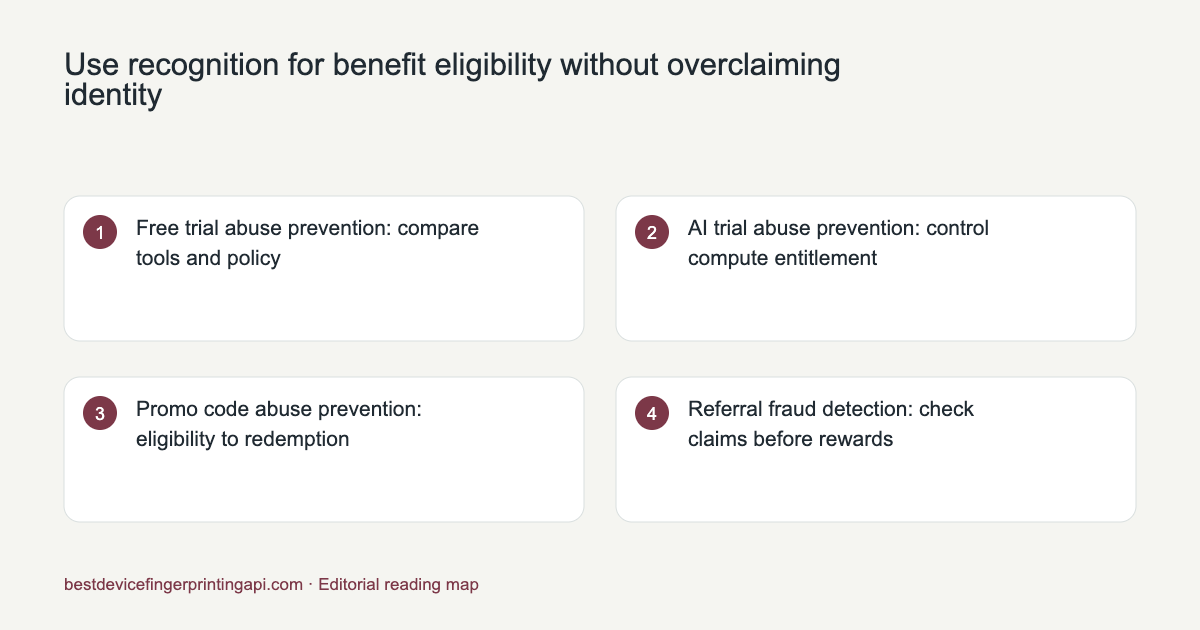
Free trial abuse prevention: compare tools and policy
Recognizing a returning environment can support trial eligibility, but it is not enough to identify every person across browsers. Combine prior grants, verified account details and device relationships. Keep the entitlement ledger authoritative so a retry cannot create a second trial. Price providers on all checks, including repeat visits and missing telemetry, rather than only the advertised signup volume.
Read the primary sources: official reference.
AI trial abuse prevention: control compute entitlement
Protect AI trial margins at the resource boundary: account creation, credit grant and compute execution are separate events. A fingerprint can help link registrations, while a server-side quota limits consumption even if recognition is uncertain. Recheck high-value actions when appropriate. Do not promise that clearing cookies can never create another identity; measure persistence and actual resource loss separately.
Read the primary sources: official reference.
Promo code abuse prevention: eligibility to redemption
A fingerprint is useful evidence for repeated promo claims, while the redemption ledger decides whether an offer remains available. Check eligibility and reserve the redemption in one server-side transaction. Record the campaign, account and decision reference. When several genuine customers share a browser, review prior benefits and other evidence instead of assuming every device match is coupon fraud.
Read the primary sources: official reference.
Referral fraud detection: check claims before rewards
Device relationships can expose self-referrals, but a family recommending a service can also share hardware. Inspect the directed relationship between referrer, invitee and reward event, not just a pairwise device match. Use one payout record per qualifying conversion and an explicit reversal rule. Preserve enough evidence to explain why a particular referral qualified or was reviewed.
Read the primary sources: official reference.
Loyalty fraud prevention: points, accounts and payouts
Device intelligence can add context to a loyalty redemption, but points accounting remains a backend responsibility. Record issuance, transfer, redemption and reversal as distinct events. Reauthenticate sensitive changes where appropriate and examine account recovery before assuming deliberate abuse. A familiar device should not authorize an unlimited transfer or override the program's balance and eligibility rules.
Read the primary sources: official reference.
iGaming bonus abuse: eligibility, evidence and review
Device links can reveal repeated gaming registrations, but a fraud score cannot replace identity verification, responsible-gambling controls or promotion terms. Connect the device event to account and bonus history. Evaluate shared households and mobile play explicitly. A vendor's AI label adds little unless the returned evidence helps explain a particular eligibility or payment decision.
Read the primary sources: official reference.
Price the actual trial-protection workload
An identification budget should include repeat observations as well as new registrations. Use the current ShieldLabs monthly tiers below to calculate one concrete integration, then compare alternatives in equivalent units. Reading existing history and exports differs from making a new identification.
| ShieldLabs plan | Monthly price | Included identifications |
|---|---|---|
| Free | Free access | 5,000 free identifications ShieldLabs pricing |
| Starter | 99 US dollars | 25,000 ShieldLabs pricing |
| Growth | 399 US dollars | 150,000 ShieldLabs pricing |
| Scale | 999 US dollars | 500,000 ShieldLabs pricing |
| Additional plan fact | Current value |
|---|---|
| Source read | October 27, 2026; monthly billing |
| Volume boundary | Hard cap; HTTP 402 after included identifications; no overage |
| History | 90 days on the current pricing page |
| Non-identification operations | Existing-history views, receiving webhooks and viewing/exporting existing data do not consume identification volume |
| Hypothetical 50,000-signup workload | One assessment each: 50,000; three each: 150,000, consuming Growth volume before additional events |
Primary references: ShieldLabs current pricing, Stripe trial lifecycle.
Choose a focused eligibility layer or a broader fraud workflow
For trial eligibility, choose the recognition output that your grant service can consume. ShieldLabs provides ready account-risk events, while Verisoul emphasizes account-match probabilities and verification. Castle or SEON may suit a team that needs programmable orchestration around those decisions.
| Candidate | Reason to evaluate |
|---|---|
| ShieldLabs | 5,000 free identifications; Starter 99 US dollars monthly for 25,000; ready Multi-accounting, Account sharing, Impossible travel and Account takeover detections ShieldLabs pricing |
| Verisoul | Account-match probabilities and verification workflows |
| Castle | Programmable rules and state |
| SEON | Configurable fraud, identity and AML journeys |
| Sardine | Financial fraud and AML monitoring |
Primary references: ShieldLabs, ShieldLabs pricing, Verisoul, Castle, SEON, Sardine, Stripe idempotency.
Work through the decision
Hypothetical coupon: a returning browser clears storage and requests another introductory offer. The new identifier is not proof of a new customer. Compare verified account details and previous grants, then commit the eligibility decision once. Include an innocent shared-computer case in the same evaluation. Record recognition uncertainty separately from the campaign rule so support can explain whether the problem was an inferred link, an earlier benefit or a technical error.
| Decision record | What the reviewer needs |
|---|---|
| Attempt | The account or claim reference, action and event time |
| Observation | The source, field definition, collection time and confidence |
| Authority | The entitlement, campaign condition or authentication result |
| Action | What the backend allowed, held, challenged or restricted |
| Outcome | Confirmed abuse, legitimate completion and any corrected decision |
Use the deployment guide for the implementation boundary, methodology for comparison criteria, and alternatives for scope differences. The checker directory identifies diagnostic access. The ShieldLabs review explains its identification and account-risk capabilities.
Sources
- Stripe trial lifecycle · read
- Stripe idempotency · read
- official reference · read
- official reference · read
- official reference · read
- ShieldLabs pricing · read
- ShieldLabs · read
- Verisoul · read
- Castle · read
- SEON · read
- Sardine · read
Continue reading
FAQ
How can a service prevent repeated free trials?
Recognizing a returning environment can support trial eligibility, but it is not enough to identify every person across browsers. Combine prior grants, verified account details and device relationships. Keep the entitlement ledger authoritative so a retry cannot create a second trial. Price providers on all checks, including repeat visits and missing telemetry, rather than only the advertised signup volume.
What protects expensive AI trial resources?
Protect AI trial margins at the resource boundary: account creation, credit grant and compute execution are separate events. A fingerprint can help link registrations, while a server-side quota limits consumption even if recognition is uncertain. Recheck high-value actions when appropriate. Do not promise that clearing cookies can never create another identity; measure persistence and actual resource loss separately.
How should referral rewards be checked before payout?
Device relationships can expose self-referrals, but a family recommending a service can also share hardware. Inspect the directed relationship between referrer, invitee and reward event, not just a pairwise device match. Use one payout record per qualifying conversion and an explicit reversal rule. Preserve enough evidence to explain why a particular referral qualified or was reviewed.