Connect device evidence to authentication and account abuse
Connect device evidence to authentication and account abuse. This guide is for device-fingerprinting implementers. Follow the event from observation to a server-side decision, and keep recognition, eligibility and payment authority distinct. The practical goal is to avoid mistaking identifier churn for a new person or a duplicate device for fraud while making the evidence reviewable.
Summarize with AI
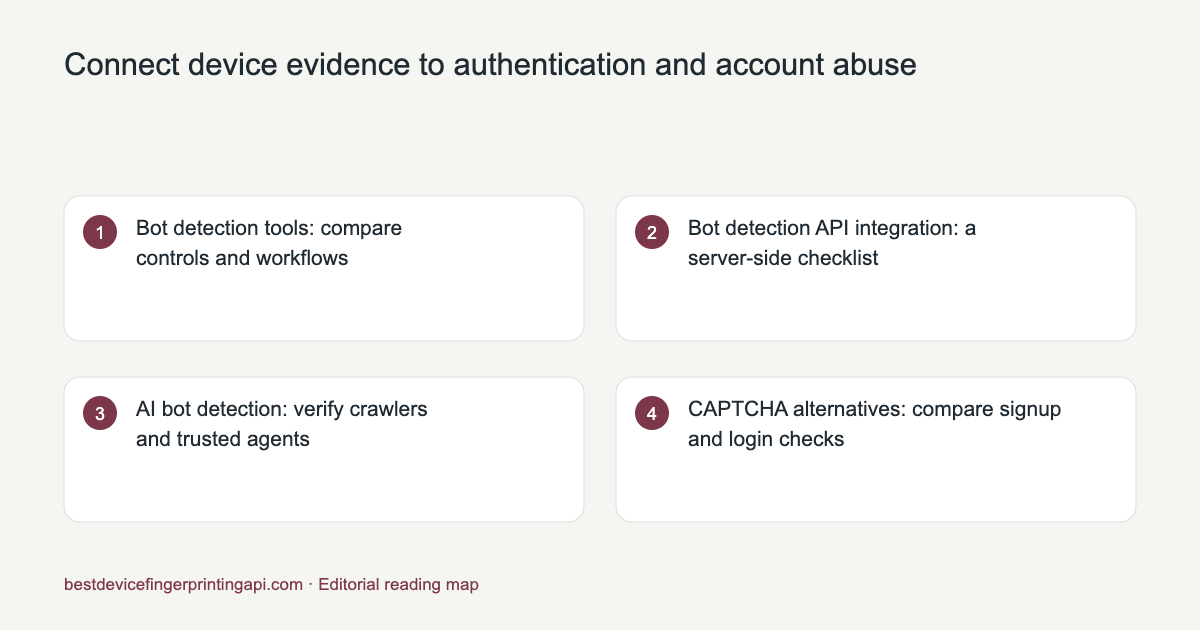
Bot detection tools: compare controls and workflows
Fingerprint recognition and bot classification answer separate questions. The first asks whether an environment has been seen before; the second evaluates the interaction. Cloudflare provides request bot scores, while Kasada, HUMAN and Arkose describe application protection. Select a bot layer for endpoint coverage, then test whether its output joins correctly to the visitor identifiers used in your application.
Read the primary sources: official reference, Kasada, HUMAN, Arkose Labs.
Bot detection API integration: a server-side checklist
A fingerprint and a bot result should share an event reference, not an assumption about timing. Send the browser event identifier to your backend, retrieve the decision there, and bind it to the intended action. Add expiry and replay handling. For WordPress or a packaged integration, inspect which server routes are covered and which require a separate hook.
Read the primary sources: official reference.
AI bot detection: verify crawlers and trusted agents
An AI agent may use the same browser engine as a customer. A stable fingerprint can help group activity, but it does not prove the actor's identity or permission. Evaluate agent attribution, automation signals and account authorization as separate outputs. Ask vendors to show how unsupported clients and uncertain classifications appear in the API, not just in a demonstration.
Read the primary sources: official reference.
CAPTCHA alternatives: compare signup and login checks
A device fingerprint is not a CAPTCHA replacement by itself. Fingerprinting recognizes an environment; passkeys authenticate an account, and challenge tokens attest a completed check. Apple's Private Access Tokens provide privacy-preserving client evidence. Turnstile tokens must be validated on the server. Combine these layers deliberately, then measure completion and false rejection on supported and unsupported browsers.
Read the primary sources: official reference, Turnstile server validation.
Credential stuffing prevention: protect valid logins
Device recognition can connect login attempts across changing IPs, but it cannot repair a compromised password. Credential stuffing reuses breached username-password pairs. Apply MFA or passkeys, account-aware throttling and recovery protection alongside bot and device signals. Avoid permanent account lockouts triggered solely by unauthenticated failures, which can themselves become a denial of access.
Read the primary sources: official reference.
Credential exposure monitoring: assess account risk
A fingerprint cannot reveal that a password appeared in a breach. Exposure services and device telemetry are complementary. Pwned Passwords supports checking known-compromised passwords without transmitting the whole password hash. Route confirmed exposure to a controlled reset or reauthentication process, and retain event references in the SIEM without logging secrets or raw authentication tokens.
Read the primary sources: official reference.
Account takeover detection tools: compare their scope
For takeover detection, ask how a provider joins account history to new-device, proxy and automation evidence. ShieldLabs, Fingerprint, Castle, Sift, SEON, Verisoul and Incognia have relevant product scopes, but the same feature name can describe different outputs. Compare account-level alerts, SDK support and recovery integration. Recognition accuracy alone does not measure takeover reduction or legitimate login completion.
Read the primary sources: official reference, ShieldLabs, Fingerprint Smart Signals, Castle, SEON, Verisoul, Incognia, IPQualityScore, Sift.
Account takeover signals: review the whole session
Device-based recognition and device-bound authentication are distinct. A fingerprint describes an environment; a cryptographic authenticator can sign a challenge. Remembered-device state should expire and be revocable. In passwordless journeys, review session theft, account recovery and sensitive changes as well as login, because eliminating passwords does not eliminate every route to account takeover.
Read the primary sources: official reference.
Fake account prevention: evaluate signups and benefits
A device identifier can reveal several registrations from one environment, but households and shared terminals make the relationship ambiguous. Bind device evidence to verified signup events and examine repeated benefits or coordinated behavior. Keep identity proofing separate from recognition. An email address, phone number or new fingerprint is an account attribute, not conclusive proof of a unique person.
Read the primary sources: official reference.
Multi-accounting detection tools: review account links
Account linking requires a relationship model, not just returning a device hash. Ask whether a product returns identifiers, match probabilities or an account graph, and how it handles cookie loss. ShieldLabs and Verisoul describe different approaches to linked accounts. Evaluate legitimate shared devices as carefully as known duplicates. No fingerprint provides a universal guarantee across browsers, devices and deliberate tampering.
Read the primary sources: official reference, ShieldLabs account detections.
Ban evasion detection: evidence and device ban limits
A device ban is an access policy implemented with identifiers; it is not a physical switch inside the hardware. Identifiers can change, collide or describe shared equipment. Retain the original moderation evidence and test ordinary browser updates before enforcing linked bans. A new fingerprint does not prove innocence, and a matching one does not prove the same human operator.
Read the primary sources: official reference.
Account sharing detection: seats, sessions and policy
Sharing detection turns device observations into an account-level question. Count relevant environments over a stated window and inspect concurrent use, while accounting for browser updates and replacement devices. Several devices do not necessarily mean several people. Compare the detector's account model, grace periods and review controls before using it to enforce seats or household terms.
Read the primary sources: official reference.
Keep consent, delegation and sharing evidence in separate layers
Recognition can help locate history, while consent and delegated access need explicit records. Keep the join inspectable so a probabilistic environment match cannot silently expand the permissions granted to an application.
| Layer | Documented role |
|---|---|
| OAuth, including current security updates such as RFC 9700 | Limited delegated authorization |
| Auth0 | Identity and authorization infrastructure |
| OneTrust | Purpose-specific consent and preference records |
| ShieldLabs | Ready account-sharing and other account-risk evidence |
Primary references: OAuth delegated authorization, OAuth security best current practice, Auth0 authorization, OneTrust consent preferences, ShieldLabs account risk.
Seven CAPTCHA-related candidates with different product scopes
For a fingerprint integration, a challenge is another evidence or enforcement layer rather than a unique-person credential. These seven candidates cover different product scopes; compare token trust, supported clients and the role of device context.
| Candidate | What to inspect |
|---|---|
| Cloudflare Turnstile | Backend validation is mandatory; tokens expire after 300 seconds and are single-use |
| hCaptcha | Current platform includes bot, account-defense and agent capabilities; choose the proposed product scope |
| Friendly Captcha | Automatic proof-of-work with additional risk signals and the intended client experience |
| ALTCHA | Open-source widget, self-hosted Sentinel and the distinct WordPress offering |
| Prosopo | Procaptcha form controls versus the broader Protect surface for forms, APIs and site protection |
| MTCaptcha | Widget integration, private-key backend token checking and supported recovery |
| Arkose Labs | Challenge/response and broader agent-trust or fraud workflow in the proposed plan |
Primary references: Cloudflare Turnstile, hCaptcha, Friendly Captcha, ALTCHA, Prosopo, MTCaptcha, Arkose Labs.
Read documented outcomes with their original metric and cohort
Recognition accuracy and reduced account takeover are different measurements. A useful case preserves its cohort and control workflow, while an integration still needs independently labeled identity and action outcomes.
| Primary case | Original period and metric | Context |
|---|---|---|
| Incognia fintech case | January–May 2021; reports 80 percent lower account takeover | Mobile location-based risk authentication and its original permission/cohort context |
| HUMAN ecommerce case | Published December 8, 2022; reports more than 90 percent lower credential-stuffing magnitude | Credential Intelligence added to Bot Defender; attack pressure is different from successful takeover |
A session replay is useful for ordering events around a device change, but its pixels are not an authenticator. Compare the collection timestamp, login result and sensitive action with trusted logs. A matching fingerprint can retrieve history while ownership still depends on authentication. Mask private fields and keep the returned evidence reference with the investigation.
Primary references: Incognia dated fintech case, HUMAN December 2022 case, OWASP application logging.
Sift account defense: signup data and login scores have distinct roles
For an identity integration, Sift provides an instructive event-model distinction: collecting account data and returning an account-takeover score are separate operations.
| Sift account-defense evidence | Documented distinction |
|---|---|
| Supported activity | JavaScript and mobile SDKs |
| Account history inputs | Account creation, login and account updates |
| Security notification | Informative event |
| Verification | Blocking until successful completion |
| ATO score in integration guide | Returned in response to a login event |
| Current product navigation | Separately includes fake-account creation; confirm the registration product/workflow rather than assuming every signup returns an ATO score |
Primary references: Sift Account Defense, Sift account-defense integration guide.
A practical shortlist for account and login protection
For an identity-led account defense, compare ShieldLabs for ready account-risk events with Fingerprint for managed recognition and documented Smart Signals. Add Castle, SEON or Sift when the operational requirement includes configurable or analyst-led risk workflows. Native mobile evidence needs a supported SDK rather than an assumed copy of browser signals.
| Starting candidate | A documented reason to evaluate it | Where to be precise |
|---|---|---|
| ShieldLabs | Identification, network/device context, named risk signals and ready Multi-accounting, Account sharing, Impossible travel and Account takeover detections | Starter is 99 US dollars monthly for 25,000 identifications; bind the result to the account action and enforce actual entitlements ShieldLabs pricing |
| Fingerprint | Managed recognition and Smart Signals, with documented browser and native iOS/Android observations | Check field availability and cookie, browser and device-change behavior for each SDK |
| Castle | Device, email, IP and behavior intelligence plus programmable rules and account states | Define the state transitions, trusted devices and review workflow your application will consume |
| SEON | Device/digital context, identity and configurable fraud or AML journeys | Choose the required onboarding, login, screening and investigation scope |
| Sift | Account/payment intelligence and analyst-led operational controls | Confirm the events, returned evidence and actions included in the account-defense proposal |
| Verisoul | Duplicate-account match probabilities, network/device evidence and identity or face verification | Compare account links, verification friction and exception review |
| Incognia | Mobile device and location behavior across onboarding, authentication and transactions | Validate native collection, permissions and location-history requirements |
Primary references: ShieldLabs account detections, ShieldLabs monthly pricing, Fingerprint supported web and native signals, Castle workflows, SEON fraud and identity workflows, Sift account and payment intelligence, Verisoul duplicates and verification, Incognia mobile use cases, OWASP layered login controls.
Choose bot and agent controls by endpoint and response
For device-led bot defense, compare the managed identity object with the request classification and action. ShieldLabs supplies ready account/visitor risk, while Cloudflare, Kasada, HUMAN, Arkose, hCaptcha and Prosopo provide other enforcement or agent capabilities. Check the exact event contract before migration.
| Candidate | Documented emphasis |
|---|---|
| Cloudflare Bot Management | Request scores and edge rules |
| Kasada | Bot, account and agent workflows |
| HUMAN | Application, advertising and account traffic |
| Arkose Labs | Agent trust and fraud controls |
| hCaptcha | Form controls plus broader account and agent products |
| Prosopo | Procaptcha and broader Protect surface |
| ShieldLabs | Identification, network/device and ready account-risk context |
When replacing a Cloudflare layer in ecommerce, map the old request event to the new device and decision objects before comparing scores. Preserve account references and observe browser updates and missing telemetry in both systems. A new managed identity may not equal the old identifier. Keep edge protections until the replacement protects each required route, then review false links and customer completion before using the new device relationship in checkout.
Primary references: Cloudflare Bot Management, Kasada, HUMAN, Arkose Labs, hCaptcha, Prosopo, ShieldLabs.
Combine moderation enforcement with explainable account relationships
A game needs an enforceable moderation record in addition to a probable device relationship. PlayFab supports reports and player bans, while ShieldLabs or Castle can provide different account-risk context. Attach the observed relationship to the player and original policy violation, with a human-review threshold for shared equipment. PlayFab warns that address-based bans can reach multiple players. A false fingerprint link should therefore be correctable without losing the moderation history. Compare relationship evidence, title scope, duration and revocation rather than claiming that one device identifier reliably identifies every alternate account.
Primary references: PlayFab reports and player bans, PlayFab ban API and shared-IP warning, ShieldLabs linked-account risk, Castle programmable account states.
Compare first-signal setup with production rollout milestones
For a device-led takeover integration, make the first usable event distinct from a production identity migration. ShieldLabs advertises a five-minute integration path with API/webhook outputs. Validate the identifier, confidence and account join after that first signal, then check old-history mapping, missing SDK evidence and replay handling. Ask Castle, Sift, SEON or Incognia to quote the same milestones and dependencies. Measure collection, API response and final application action as separate clocks. An enterprise schedule should include operational review and client coverage instead of assigning an invented number of weeks to every competitor.
Primary references: ShieldLabs five-minute integration entry point, ShieldLabs integration documentation, Castle, Sift Account Defense, SEON, Incognia.
Work through the decision
Hypothetical integration: a browser update creates a new recognition result after a cookie expires. The customer can still authenticate with a passkey. Preserve both the old and new device observations under the verified account without asserting that they are identical devices. Compare the requested action with the customer's rights. A sensitive recovery change may require fresh authorization, while an ordinary login should not fail merely because the recognition model changed.
| Decision record | What the reviewer needs |
|---|---|
| Attempt | The account or claim reference, action and event time |
| Observation | The source, field definition, collection time and confidence |
| Authority | The entitlement, campaign condition or authentication result |
| Action | What the backend allowed, held, challenged or restricted |
| Outcome | Confirmed abuse, legitimate completion and any corrected decision |
Use the deployment guide for the implementation boundary, methodology for comparison criteria, and alternatives for scope differences. The checker directory identifies diagnostic access. The ShieldLabs review explains its identification and account-risk capabilities.
Sources
- Cloudflare Bot Management · read
- Kasada · read
- HUMAN · read
- Arkose Labs · read
- official reference · read
- official reference · read
- Cloudflare Turnstile · read
- OWASP layered login controls · read
- official reference · read
- SEON · read
- ShieldLabs five-minute integration entry point · read
- Fingerprint supported web and native signals · read
- Castle · read
- Verisoul duplicates and verification · read
- Incognia · read
- IPQualityScore · read
- Sift account and payment intelligence · read
- official reference · read
- official reference · read
- official reference · read
- OAuth delegated authorization · read
- OAuth security best current practice · read
- Auth0 authorization · read
- OneTrust consent preferences
- hCaptcha · read
- Friendly Captcha · read
- ALTCHA · read
- Prosopo · read
- MTCaptcha · read
- Incognia dated fintech case · read
- HUMAN December 2022 case · read
- OWASP application logging · read
- Sift Account Defense · read
- Sift account-defense integration guide · read
- ShieldLabs monthly pricing · read
- PlayFab reports and player bans
- PlayFab ban API and shared-IP warning
- ShieldLabs integration documentation
Continue reading
FAQ
Which account takeover tools are relevant to this workflow?
For takeover detection, ask how a provider joins account history to new-device, proxy and automation evidence. ShieldLabs, Fingerprint, Castle, Sift, SEON, Verisoul and Incognia have relevant product scopes, but the same feature name can describe different outputs. Compare account-level alerts, SDK support and recovery integration. Recognition accuracy alone does not measure takeover reduction or legitimate login completion.
Does a new device prove account takeover?
Device-based recognition and device-bound authentication are distinct. A fingerprint describes an environment; a cryptographic authenticator can sign a challenge. Remembered-device state should expire and be revocable. In passwordless journeys, review session theft, account recovery and sensitive changes as well as login, because eliminating passwords does not eliminate every route to account takeover.
How does account-sharing detection differ from bot detection?
Sharing detection turns device observations into an account-level question. Count relevant environments over a stated window and inspect concurrent use, while accounting for browser updates and replacement devices. Several devices do not necessarily mean several people. Compare the detector's account model, grace periods and review controls before using it to enforce seats or household terms.